The hierarchy of cosmic
bodies.
Planetary systems, stellar and galactic systems, all have the same functional
structure: Vector space oriented in orthogonally closed circuits.
The difference between these systems is size and time, existence, life.
In the activity of very massive stars, photospheric protuberances have
formed many large stars—the arms of a galaxy. The stars within the
galactic
arms, through photospheric activity, evolve into stellar systems by generating
smaller stars, which in turn will become planetary systems. The hierarchy
of macroscopic vectorial structures brings biospheres to the planets.
The evolution of a planetary system.
Earth is a planetary system—initially a small star with a photosphere.
The activity of the photosphere oriented vector space into orthogonally
closed macroscopic circuits, a satellite, the Moon. Over time, the gradient-
oriented vector space decreased and the Earth's photosphere became the
lavasphere. The density of the oriented vector space in the lavasphere
layer
being lower, the hydrogen dynamics unites the structures, composes and
decomposes the native elements, forming the lithosphere. In addition,
the
dynamics of the lavasphere presents lacunae in the polar zones, due to
the
high density of the vector space oriented in the gradient axis. For this
reason,
the activity of the lavasphere decreases towards the tropics. The activity
of
the lavasphere, earthquakes and volcanic eruptions, shaped the relief
of the
earth's crust, and the deposition of elements through eruptions continues
even now. This explains the mountainous areas, the ocean abysses and the
"ring of fire". The dynamics of the lavasphere maintain a constant
temperature, which gives the false impression that the temperature increases
towards the center of the earth. The activity of the terrestrial lavasphere,
like
the photosphere of the sun, floats on the dark sphere, being limited by
the
exponential growth of the density of the gradient-oriented vector space.
The effects of the lavasphere, combined with the effects of sunlight,
determined the evolution of the environment on the Earth's surface.
Evolution is well known historically, the emergence of vector biostructures,
the plant kingdom, which covered the land with forests, but also the oceans
with plankton. The photosynthesis process of the plant kingdom, of forests,
absorbing carbon and releasing oxygen into the atmosphere, established
the
balance of the atmospheric climate. As a result, primitive forms of plant
parasites developed on plant organisms, from which the animal kingdom
evolved through mature selection. In the climatic balance sustained by
the
plant kingdom and the water cycle, the animal kingdom evolved through
natural selection, up to the most fierce parasite of the plant kingdom,
the
human species. Among the scalar and vector physical quantities of nature,
human civilization has considered that the fundamental form of nature's
existence is matter. Within the framework of the materialist worldview,
vector quantities are considered properties of matter. This conception
defines energy as a function of the state of matter, that is, the movement
of matter. The definition imposed, purely and simply, the materialistic
interpretation of the electrical phenomenon, through the "current"
of electrical
charges, through the movement of electrons. Energy is the effect of a
cause,
and causes are the interactions of vectorial properties. The social development
of human civilization based on the materialist conception is already history.
In this context, the creation of "electronic" devices for communication
and
movement—ranging from humanoid robots to AI—is of particular
interest.
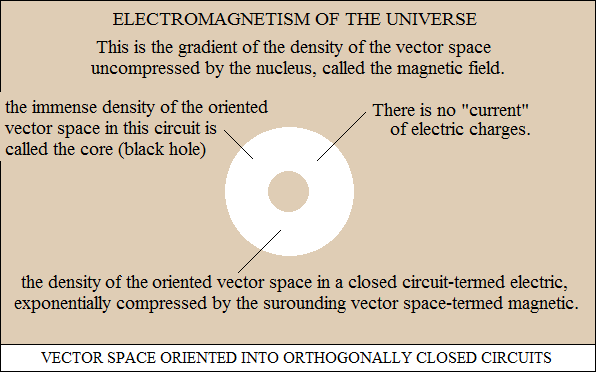
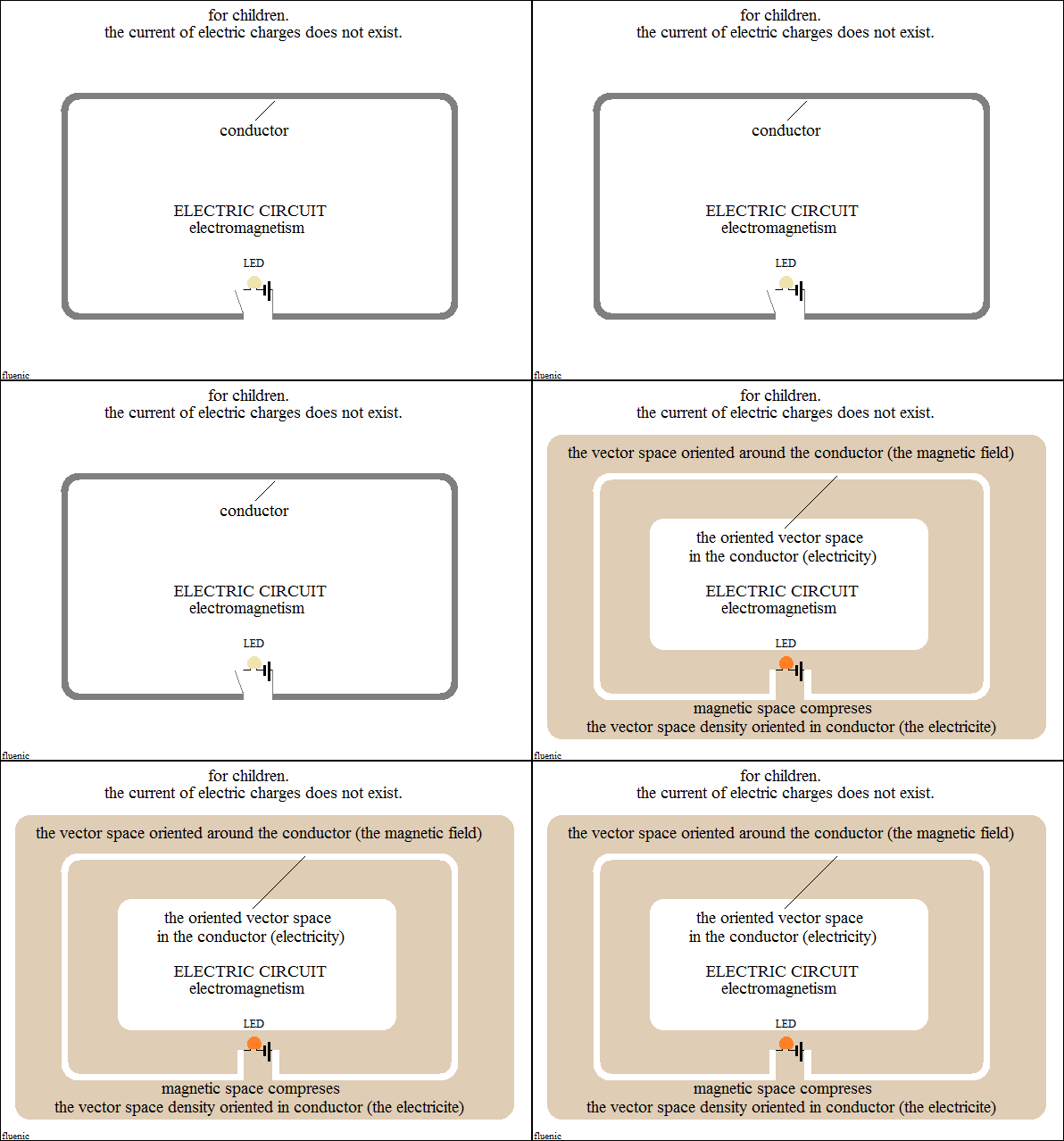
Electricity is the vector space, oriented in orthogonally closed circuits.
The "electrical" circuit is the vector space oriented through
the conducting
wire (discovered by Stephen Gray). The "magnetic" circuit is
the vector
space oriented around the conductor, if and only if the circuit through
the
conductor is closed (discovered by Hans Christian Ørsted).
The interactions of vector properties (energy) demonstrate that any
movement in nature is the effect of the interaction of vector properties.
Communication with the Morse code, with the telephone, the light bulb,
the LED, photography, logic gates, all are empirical achievements,
without knowing that in reality they are interactions of vector properties,
of vector space. The concrete example is the lift of the airplane, an
interaction with vector space, identical to the "centrifugal force".