Planet with biosphere.
In nature there are two physical quantities, scalar quantities, that is,
matter,
and vector quantities. Of these quantities, terrestrial civilization considered
that the fundamental form of nature's existence is matter. The development
of civilization, interpreting the phenomena of nature with this conception,
has proven to be wrong, destructive for the biosphere of the earth. The
sun
is not a sphere of hot plasma compressed by gravity. The Earth is not
a
sphere of matter compressed by gravity. Electricity is not a current of
material particles. The universe is not the result of a big explosion,
which formed matter. The fundamental form of nature's existence is the
interactions of vector properties, that is, energy, in the form of vector
space.
Vector space oriented in orthogonally closed circuits forms macroscopic
(stars) and microscopic (hydrogen) vector structures, the so-called "matter".
The interactions of the already known vector properties, the attraction
and
repulsion of vectors can occur omnidirectionally, that is, "three-dimensionally".
So, the three-dimensional space is the vector properties - the vector
space.
Energy is the effect of a cause and the causes are the vector interactions.
Time is the measure of the evolution of vector interactions, of energy,
their
absence being nonexistent. Vector space orients itself in orthogonally
closed
circuits, vortices. In the closed vector circuit, the vector property
of axial
rotation orients the vector space around the circuit, in another circuit,
orthogonally closed. In reality, the axial rotation property of the vectors
simultaneously and reciprocally closes the orthogonal orientation of the
circuits, forming a vector structure. In asymmetric macroscopic vector
structures, the axial rotation of the vectors generates the differential
rotation
of the structure, known as vortices. Such structures are the bodies of
the
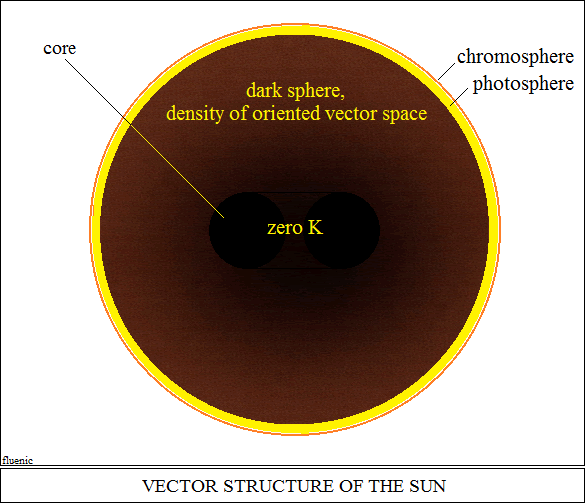
universe, "read" in the structure of the Sun. The Sun is a structure
of vector
space oriented in orthogonally closed circuits. In orthogonally closed
circuits,
the modulus of vectors tends to zero, to a null vector, and the forces
of
attraction thus become centripetal forces, which mutually compress the
density of the space oriented in circuits. Macroscopic vector structures
are
asymmetric, the space of one circuit being completely surrounded and
compressed by the centripetal forces of the other circuit, taking the
function
of the nucleus. The centripetal forces of the nucleus compress the space
oriented in the orthogonal circuit, only the segment they surround.
The vector repulsive forces of the parallel oriented vector space in the
uncompressed circuit expand the density of the space, until it is balanced
with the centripetal vector forces (of attraction). The vector space in
the
uncompressed circuit of the Sun thus reaches the dimension of two light
years and constitutes the gradient of the density of the oriented
vector
space, the extent of the solar system. In the Sun's gradient, the density
of the oriented vector space increases exponentially towards the nucleus.
The high density around the nucleus thus forms a dark sphere, with a
temperature of zero K. This is the structure of the Sun, the vector space
mutually conserved by the two orthogonally closed circuits, the gradient
and the nucleus, with potential energy. The density of the oriented
vector
space in the layer on the surface of the dark sphere is conducive to the
formation of microscopic vector structures, hydrogen. In the density of
the
layer, the hydrogen structures, increasing their density, fall towards
the
center, towards the dark sphere, as Archimedes' law says. The density
of the gradient-oriented vector space physically justifies Archimedes'
law,
disproving gravity. The strongly oriented vector space from the dark sphere
aligns the space in the hydrogen structure, which enters into oscillations,
to
decompose. The hydrogen with the low density of oscillations is moved
upward, according to Archimedes, and the cycle repeats itself continuously.
The dynamics of hydrogen composition/decomposition, forms the
photosphere of the Sun, with the known light and temperature. Obviously,
the photosphere is the only kinetic state of energy in the Solar structure,
which represents the activity of the Sun and which formed the chromosphere
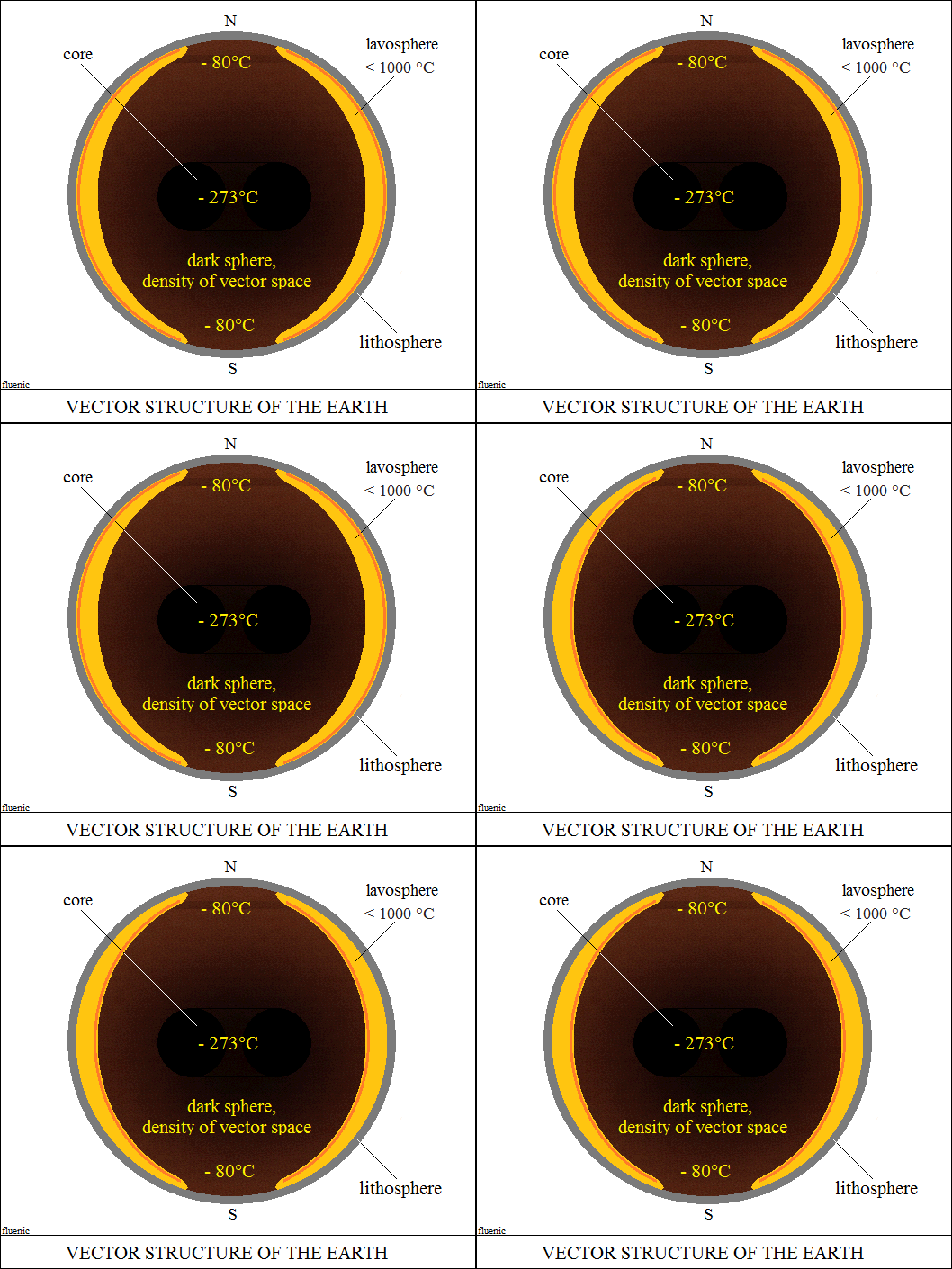
and the planets. Likewise, the Earth's lavasphere formed the native elements
and the lithosphere. The planets, being included in the Solar gradient,
are
moved en bloc, with the differential rotation of the Sun, producing the
illusion of revolutions in orbits. The Moon, moved simultaneously with
the
differential rotation of the Earth, gives the illusion of rotation around
the Earth.
The same dynamics of the photosphere is the vaporization/condensation
of
water in the Earth's atmosphere, in the form of falling water and hail,
according to Archimedes' law. Newton interpreted the fall of bodies as
a
force of mutual "attraction" between bodies, extended to a universal
level.
To quantitatively express the force of attraction, Newton proposed the
notion of "heavy mass". Einstein remodeled gravitational attraction,
in
which heavy mass does not produce an attractive force, but rather the
curvature of "space-time", inspired by Kepler's laws. Through
his laws,
Johannes Kepler unknowingly described the differential rotation of the
Solar gradient and implicitly of the planetary systems contained within
it.
Ellipticity being vertical oscillations, crossing the densities of space
with
different rotation speeds in the gradient (apogee/perigee),
describes the differential rotation of the Sun, Kepler's ellipse.