Formation of native
elements.
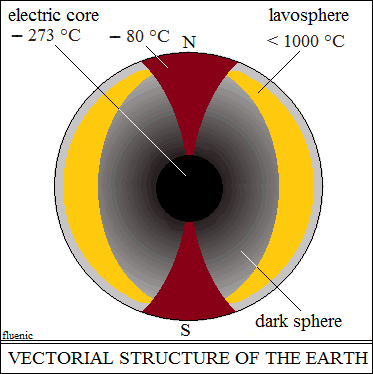
The lavosphere is the transition of the terrestrial photosphere into the
chromosphere, as Jupiter now shows, then into the lavosphere.
In the lavasphere, the diminished gradient of the density of the oriented
vector space, at the external surface of the lavasphere, composes with
the hydrogen structures, the native elements. The high density of the
oriented space in the new structures, moves them towards the center.
Having reached the internal surface of the lavasphere, the density of
the
terrestrial gradient partially transforms the potential energy of the
new
structures into kinetic energy, into oscillations (temperature). With
the
decreased density, the structures are moved towards the external surface.
The dynamics of native elements in the lavasphere is the effect of the
terrestrial gradient, of the density of the oriented vector space, increasing
exponentially towards the center. The large difference in the density
of the
oriented vector space, between the internal and external surface of the
lavasphere, produces the activity of the lavasphere. The "hottest"
vector
interactions are between the internal surface of the lavasphere and the
gradient of the "cold plate" of the dark sphere. Here, the interactions
of
vector properties demonstrate the clear delimitation of the magnitude
of the
density of the oriented vector space, of potential energy, versus oscillations,
of kinetic energy. Inward, the dark sphere, with the exponential increase
in
the density of oriented (magnetic) vector space, makes the existence of
other
orientations of vector space impossible. The same density produces the
lift
effect of monorails. In the dynamics of the lithosphere, interactions
make
possible multiple vector connections, forming on the external surface
a crust with mineral substances, the lithosphere, on which the
hydrosphere floats. The structures of stars and planets are
the result of interactions of vector properties, of vector space